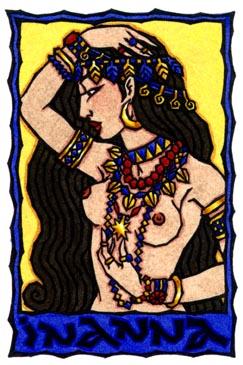
In her book, The Earth Path, Starhawk asks us to meditate on the question, What is sacred to you? The answer to that question is your sacred intention, a touchstone for making your way in the world. My answer is the freedom and creative energy of women.
Freedom is sacred because the psyche needs to be free to create. The great South African anti-apartheid activist Stephen Biko said that "the greatest weapon of the oppressor is the mind of the oppressed." Imagination born of psychic freedom is crucial for changing the world. Also, we must be free in a physical sense. Creativity relies on nourishing external circumstances. Thus my conception of freedom isn't just negative - e.g. keep your laws off my body - it's also robustly positive: give me the things I need to create. Support women's creative lives. Our salvation lies in our creativity - the free run of our creativity, unhindered by fear, lusciously supported. Thus my sacred intention is to foster and defend the freedom and creative energy of women. Is that too abstract? I see that intention in much that I do: creating my own life as a work of art, teaching, financially supporting women artists and collecting their art, encouraging and inspiring others, defending women's reproductive (creative) freedom.
What would the world be like if our social, political, and economic systems all cherished what is most sacred to you?
There would be programs in the schools to foster girls' creativity. There would be all kinds of social supports for people so they could follow a creative path. Information would be easy to obtain. Women's art would be valued. There would be money for art and other creative endeavors. There would be other standards for value. Women's reproductive needs would be met. We would see women as the powerful, wise, creative, and sacred people that we are. There would be gorgeous, well-funded, free lending libraries for books, but also for other materials used to make art. Skills would be openly shared. There would be ample time to dream. There would be vital connection with nature, community, and one another. We would all pursue work we love and the world we want; yet all our needs would be provided for, and there would be some luxuries, too. Women would be changing the world all the time, and there would be plenty of funding.
Children would be cherished. Life would begin, not end, at birth. (For right wingers, life begins at conception and ends at birth.) Work would be shared. Emotions would be valued, and we would be educated in emotions. For example, we would learn when our emotions are true guides for us and when they lead us astray. We would learn to be grounded in our bodies and our communities, because creativity requires self-knowledge and context. We would encourage each other in all kinds of creative expression. No one would learn perfectionism. Everyone would dress however they liked, to express themselves or not, as they chose. Vitality would be encouraged, in our bodies - food and exercise and rest, plus good health care; in our minds - activated or quiet (we would learn both); in our work. Health would never be sacrificed to other ends - well, except sometimes pleasure. We would value rest. We would value dreams. We would love and comfort one another. Women's sexual pleasure would be honored and protected as sacred. We wouldn't have to work for mere subsistence; we would have enough. We would applaud and encourage new ways of thinking, rather than fearing them. We would not live in fear. We would recognize our moral duty to care for the least among us and not to kill one another. Prisons, too, could foster creativity and groundedness. No one would have a child unless she wanted one, and she would never be left to raise her children alone. Girls wouldn't become pregnant unless they really wanted to be, unless they conceived of that pregnancy and child as an integral part of their lives.
Does any part of the world already value these things? There are pockets of resistance. There are people like Heather Corinna and Margaret Cho creating this world. There are creative anarchists. There are political movements. There are women defending the front lines and women dreaming new dreams.
1. There are librarians fighting for our rights to knowledge, information, art, and privacy.
2. There are women writing (including bloggers).
3. There are women practicing magic.
4. There are women leading political movements, like RAWA and Code Pink and Wangari Maathai's Green Belt Movement.
5. There are anarchist health collectives, like the Ithaca Health Alliance.
6. There is the women's sexuality movement.
7. There are women publishing magazines and on-line journals.
8. There are women seeking the Goddess.
9. There are women organizing in their own communities.
10. There are women making art and music on their own terms, industries be damned.
11. Women are developing new, democratic ways of gaining access to creativity: Deena Metzger, Natalie Goldberg, and Julia Cameron.
Showing posts with label Starhawk. Show all posts
Showing posts with label Starhawk. Show all posts
Saturday, March 19, 2005
Friday, March 18, 2005
Knowing the land
For me, now, the Goddess is the name we put on the great processes of birth, growth, death, and regeneration that underlie the living world. The Goddess is the presence of consciousness in all living beings; the Goddess is the great creative force that spun the universe out of coiled strings of probability and set the stars spinning and dancing in spirals that our entwining DNA echoes as it coils, uncoils, and evolves. The names and faces we give the Goddess, the particular aspects she takes, arise originally from the qualities of different places, different climates and ecosystems and economies.
- Starhawk, from her most recent book, The Earth Path
I like this definition of the Goddess. It challenges me, not to anthropomorphize "her."
Knowing the land means knowing the gods of a place. I've lived here for nearly ten years, but would I recognize a god if I met one? What do I know of the indigenous people who lived here, and who live here still? What do they worship? How do they know the land? What happened to them? What is happening to them now? Here there are goddesses and gods of green valleys, of gorges and lakes and hidden swimming places, of forests taking back the land, of long winters. Of waterfalls and sunsets over the lake and moon rises. Of drumming circles and Tibetan Buddhists. Of organic farms, of idealistic peoples, of the women's rights movement and abolition and the Underground Railroad.
I met a witch from Iowa who said he has trouble sleeping anywhere he doesn't know the land. Yet how well do I know the land, here? I eat her food. I swim in her waters. I walk her tended paths. I ski in winter. I lie in the summer grass and bathe in waterfalls. A friend has tried to teach me the names of trees when we walk in nature, but I'm a careless student. I look for the weed-herbs I know wherever I walk: burdock, dandelion, red clover. I've picked weeds for wild salads and worked on the farms that grow my food. I tended an herb garden at my old apartment, where I had a yard, and I led rituals there. Now I grow herbs on my front stoop and dry them in my hallway.
Witches regularly invoke elementals: spirits of earth, air, fire, and water. When we work indoors we "visualize" the loamy scent of freshly turned earth, the sound of waves breaking, dry desert heat, wind cooling the face. But magic has its source not in my consciousness, but in the earth itself. Magic may involve the art of changing consciousness at will, as the saying has it, but it's not the art of changing the world at will, even if that's the way it's often portrayed in popular tales. Understanding the way the world works is crucial to working magic. And while third-person, scientific knowledge is a fine thing, I think the kind of knowledge intimately tied to magic is phenomenological or experiential. What is it like to be a human being in this world? What does the world feel like from within your skin? To work magic, I need to know what it's like to be me, this human animal, in this place.
- Starhawk, from her most recent book, The Earth Path
I like this definition of the Goddess. It challenges me, not to anthropomorphize "her."
Knowing the land means knowing the gods of a place. I've lived here for nearly ten years, but would I recognize a god if I met one? What do I know of the indigenous people who lived here, and who live here still? What do they worship? How do they know the land? What happened to them? What is happening to them now? Here there are goddesses and gods of green valleys, of gorges and lakes and hidden swimming places, of forests taking back the land, of long winters. Of waterfalls and sunsets over the lake and moon rises. Of drumming circles and Tibetan Buddhists. Of organic farms, of idealistic peoples, of the women's rights movement and abolition and the Underground Railroad.
I met a witch from Iowa who said he has trouble sleeping anywhere he doesn't know the land. Yet how well do I know the land, here? I eat her food. I swim in her waters. I walk her tended paths. I ski in winter. I lie in the summer grass and bathe in waterfalls. A friend has tried to teach me the names of trees when we walk in nature, but I'm a careless student. I look for the weed-herbs I know wherever I walk: burdock, dandelion, red clover. I've picked weeds for wild salads and worked on the farms that grow my food. I tended an herb garden at my old apartment, where I had a yard, and I led rituals there. Now I grow herbs on my front stoop and dry them in my hallway.
Witches regularly invoke elementals: spirits of earth, air, fire, and water. When we work indoors we "visualize" the loamy scent of freshly turned earth, the sound of waves breaking, dry desert heat, wind cooling the face. But magic has its source not in my consciousness, but in the earth itself. Magic may involve the art of changing consciousness at will, as the saying has it, but it's not the art of changing the world at will, even if that's the way it's often portrayed in popular tales. Understanding the way the world works is crucial to working magic. And while third-person, scientific knowledge is a fine thing, I think the kind of knowledge intimately tied to magic is phenomenological or experiential. What is it like to be a human being in this world? What does the world feel like from within your skin? To work magic, I need to know what it's like to be me, this human animal, in this place.

Subscribe to:
Posts (Atom)