Spirit is not separate from Matter. I don't believe with some people of faith that Spirit was inserted into Matter at some point in Creation. Neither do I believe with some Buddhists that Spirit is ultimately the important thing.
Spirit and Matter are co-dependent. They are so inextricably intertwined in one another that not even death completely separates them. Spirit suffuses every atom of Matter, and Matter interpenetrates Spirit from each and every one of those atoms. Spirit Matters, and Matter is en Spirited.
Thus the conclusion that Earth is Primary is inescapable. Our landbase is what makes our consciousness of Spirit possible....
Life does indeed teach Life, and toxified and sickly Life can only inform pathologically.
Showing posts with label Earth. Show all posts
Showing posts with label Earth. Show all posts
Tuesday, December 09, 2008
Spirit is not separate from Matter
Terri writes this incisive bit of thealogy at her blog:
Monday, March 03, 2008
Holiness
I spent the weekend, and my birthday, at the mystery school, assisting the 2nd-year class. We were studying a defense structure--called the schizoid defense by Reich--that is deeply conflicted about being incarnate, being human, living on earth. This defense is characterized by anxiety and fear, and the experience is often one of fragmentation and "checking out." Spending the weekend in that energy was challenging; I found myself feeling distracted, fidgety, irritable. The curative is to ground.
I found myself thinking about one of the tenets, if you will, that I value most in Wicca: life on this earth is utterly sacred and holy. Divinity isn't elsewhere; it's right here. In this moment, in this body, on this land. To hate any part of that, or to wish that it were different, is to fragment, to cut ourselves off from Goddess. If we Witches had blasphemy, that would be it. But the concept of blasphemy connotes blame, and we can't blame ourselves for wanting to escape or for desiring things to be different. That, too, is part of what it means to be human.
I found myself thinking about one of the tenets, if you will, that I value most in Wicca: life on this earth is utterly sacred and holy. Divinity isn't elsewhere; it's right here. In this moment, in this body, on this land. To hate any part of that, or to wish that it were different, is to fragment, to cut ourselves off from Goddess. If we Witches had blasphemy, that would be it. But the concept of blasphemy connotes blame, and we can't blame ourselves for wanting to escape or for desiring things to be different. That, too, is part of what it means to be human.
Friday, June 08, 2007
The Land, a sense of place, community, and home

Part of my spiritual practice is to pay attention to the patterns that arise as I move through my life. The idea of community has been “up” for me for several months. My third year of the mystery school has been about learning how I am in community: what roles do I play? Where do I show up or fail to show up? How important do I believe my presence in the lives of others is? What defenses do I use to keep myself out of relationship? What role does community play in my larger life story? (I’m thinking of all those planets in the 11th house in my natal chart.)
Lately Pagan bloggers have been writing about community and place, and a friend has been writing me long emails about the concept of home. This morning, Garrison Keillor devoted The Writer's Almanac to Emily Dickinson, that poet who famously left home but rarely. He spoke about a time in Dickinson’s life when her community was disintegrating and she reached out, by letter, to Thomas Wentworth Higginson, asking him to be her mentor and friend. (It was clear from the way Keillor told the story that this guy had little appreciation for the kind of person who was reaching out to him, though their letters continued for the rest of her life. He didn’t like her poetry; he found her exhausting.)
As I pulled into work after dropping off Lugh at doggy daycare, I heard a song on the radio, a song that took on meaning for me first when I was 16 and my family moved from Michigan – where I had friends and community and a sense of place, however flawed – to southern Ohio, which felt foreign and hostile to me: Pink Floyd, Wish You Were Here.
Did they get you to trade your heroes for ghosts?
Hot ashes for trees?
Hot air for a cool breeze?
Cold comfort for change?
How I wish you were here.
--I observe that Pagans as a people (the Pagani, as Sara Sutterfield Winn would say) attend to the question of community. Many of us practice as solitaries, and there’s the old joke that organizing Pagans is like herding cats. Many of us long for more, or better, community. We may chafe against the Pagan community we know. There are Witch Wars. Pagans get excluded from their communities. Our problems with building community – and I do think we have some serious problems with it – stem both from our novelty as a religious movement and our location within cultures like the U.S. where community is breaking down. We occupy a unique cultural moment in which community can’t be taken for granted as the place where you’re stuck and the people you’re stuck with. Community needs to be built intentionally – and I think that’s a good thing – but I also think that most of us don’t know how to do that.
When we talk about community-building in a general way, we’re probably talking about building relationships with people. But as Pagans, we also care about building relationships with the land and its inhabitants (material and immaterial). Feeling connected to the land is important to many of us, and many of our other values emerge from that feeling - or the desire for a feeling - of connection to the land.
Hecate writes about a connection between pacifism, the Land, and having a sense of place.
Kim Antieau writes about her longing for community and how freakin’ hard it is to build community. She expresses a bewilderment that I often feel.
Molly has made connection with her land and its inhabitants central to her life, and she seems to have a knack for building community.
Updates: Sara adds her giddy voice to the brew. Executive Pagan talks about choosing to be a local.
(The photo is of the entrance to the gorge four blocks from my house.)
Sunday, July 09, 2006
Ambassadors of the earth
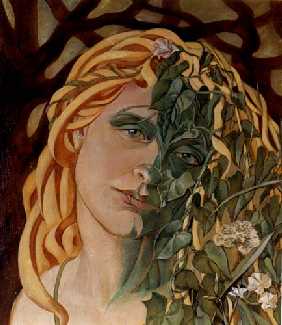 I love Pagans, and I love Pagan bloggers. I've tired of the blogosphere as of late - my other blogs lie fallow - but I keep reading (a) the gossip blogs, which somehow relax me, and (b) the Pagan blogs, which fill me and connect me to like minds.
You know what I love about Pagans? I love our connection to the natural world and the cycles of nature. Kim and Joanna, like me, write about their perfect summers days. Joanna and Sonja, like me, write about the nearly-full moon. Kim and Molly write about fairy medicine, and Sonja writes, too, about her work with the elementals. (Don't miss Kim's magical post about listening to bees.) Reya's a city girl, but she feels the need to commune with green things (check out her fabulous new photo and gray hair, too - and if you really want to be jealous, read her posts about her trip to Rome).
A dear friend of mine, someone who, constitutionally, is all air and otherworlds, and who is learning how not to flee the present when things scare her, calls me her ambassador to the earth. I love that. It's remarkable how, although we are earth's creatures, we humans try to spend so much time away from the earth - in our heads, in the mall, in denial of the "soft animals of our bodies," as Mary Oliver says. "Let the soft animal of your body love what it loves." We Pagans are ambassadors of the earth, and that, I believe, is a special role we play among our fellow earth-travelers. For keeping me connected, even in cyberspace, I thank you, Pagan sisters. Dark earthy blessings to you.
You’ve heard me say that I think we're hardwired for ecstasy. Our bodies are designed for it. I have never questioned that. So many religions and belief systems have us up in our heads all the time trying to get away from our precious, beautiful bodies. Suffering and ecstasy dwell in the same place: in our bodacious bodies. If you give up one, you have to give up the other. As one of the Old Mermaids said, "Laugh or weep. We swim in your tears." (Kim Antieau)
[The painting is "Latvian Green Woman" by Larissa Shellar.]
Friday, March 18, 2005
Knowing the land
For me, now, the Goddess is the name we put on the great processes of birth, growth, death, and regeneration that underlie the living world. The Goddess is the presence of consciousness in all living beings; the Goddess is the great creative force that spun the universe out of coiled strings of probability and set the stars spinning and dancing in spirals that our entwining DNA echoes as it coils, uncoils, and evolves. The names and faces we give the Goddess, the particular aspects she takes, arise originally from the qualities of different places, different climates and ecosystems and economies.
- Starhawk, from her most recent book, The Earth Path
I like this definition of the Goddess. It challenges me, not to anthropomorphize "her."
Knowing the land means knowing the gods of a place. I've lived here for nearly ten years, but would I recognize a god if I met one? What do I know of the indigenous people who lived here, and who live here still? What do they worship? How do they know the land? What happened to them? What is happening to them now? Here there are goddesses and gods of green valleys, of gorges and lakes and hidden swimming places, of forests taking back the land, of long winters. Of waterfalls and sunsets over the lake and moon rises. Of drumming circles and Tibetan Buddhists. Of organic farms, of idealistic peoples, of the women's rights movement and abolition and the Underground Railroad.
I met a witch from Iowa who said he has trouble sleeping anywhere he doesn't know the land. Yet how well do I know the land, here? I eat her food. I swim in her waters. I walk her tended paths. I ski in winter. I lie in the summer grass and bathe in waterfalls. A friend has tried to teach me the names of trees when we walk in nature, but I'm a careless student. I look for the weed-herbs I know wherever I walk: burdock, dandelion, red clover. I've picked weeds for wild salads and worked on the farms that grow my food. I tended an herb garden at my old apartment, where I had a yard, and I led rituals there. Now I grow herbs on my front stoop and dry them in my hallway.
Witches regularly invoke elementals: spirits of earth, air, fire, and water. When we work indoors we "visualize" the loamy scent of freshly turned earth, the sound of waves breaking, dry desert heat, wind cooling the face. But magic has its source not in my consciousness, but in the earth itself. Magic may involve the art of changing consciousness at will, as the saying has it, but it's not the art of changing the world at will, even if that's the way it's often portrayed in popular tales. Understanding the way the world works is crucial to working magic. And while third-person, scientific knowledge is a fine thing, I think the kind of knowledge intimately tied to magic is phenomenological or experiential. What is it like to be a human being in this world? What does the world feel like from within your skin? To work magic, I need to know what it's like to be me, this human animal, in this place.
- Starhawk, from her most recent book, The Earth Path
I like this definition of the Goddess. It challenges me, not to anthropomorphize "her."
Knowing the land means knowing the gods of a place. I've lived here for nearly ten years, but would I recognize a god if I met one? What do I know of the indigenous people who lived here, and who live here still? What do they worship? How do they know the land? What happened to them? What is happening to them now? Here there are goddesses and gods of green valleys, of gorges and lakes and hidden swimming places, of forests taking back the land, of long winters. Of waterfalls and sunsets over the lake and moon rises. Of drumming circles and Tibetan Buddhists. Of organic farms, of idealistic peoples, of the women's rights movement and abolition and the Underground Railroad.
I met a witch from Iowa who said he has trouble sleeping anywhere he doesn't know the land. Yet how well do I know the land, here? I eat her food. I swim in her waters. I walk her tended paths. I ski in winter. I lie in the summer grass and bathe in waterfalls. A friend has tried to teach me the names of trees when we walk in nature, but I'm a careless student. I look for the weed-herbs I know wherever I walk: burdock, dandelion, red clover. I've picked weeds for wild salads and worked on the farms that grow my food. I tended an herb garden at my old apartment, where I had a yard, and I led rituals there. Now I grow herbs on my front stoop and dry them in my hallway.
Witches regularly invoke elementals: spirits of earth, air, fire, and water. When we work indoors we "visualize" the loamy scent of freshly turned earth, the sound of waves breaking, dry desert heat, wind cooling the face. But magic has its source not in my consciousness, but in the earth itself. Magic may involve the art of changing consciousness at will, as the saying has it, but it's not the art of changing the world at will, even if that's the way it's often portrayed in popular tales. Understanding the way the world works is crucial to working magic. And while third-person, scientific knowledge is a fine thing, I think the kind of knowledge intimately tied to magic is phenomenological or experiential. What is it like to be a human being in this world? What does the world feel like from within your skin? To work magic, I need to know what it's like to be me, this human animal, in this place.

Subscribe to:
Posts (Atom)