Monday, January 22, 2007

Blog for choice


Today I'm blogging for choice.

A woman's right to make her own decisions about her fertility is inalienable and non- negotiable.

Thursday, January 18, 2007

Book review: A Mirror for Witches

Esther Forbes (1928). A Mirror for Witches. (Academy Chicago Publishers, 2006, 1985).

In a town near Salem, in the years before the famous witch trials, there lived a girl called Doll Bilby. She was born in Celtic Brittany, where her parents burned as witches before her eyes. Rescued by an English sea captain, whose wife could bear no children despite being a devout and Godly woman, the dark-haired, wild-eyed Doll - so called because she was small - came to settle with her foster parents in Massachusetts Bay Colony.

This is the setting for Esther Forbes's relentless, haunting novel of a young girl, a perpetual outsider, who falls victim to the hysteria of her times. The story is told in the authoritative voice of an "objective observer" after the fact, a Malleus Maleficarum for one girl. The unidentified narrator recalls events in Doll's life through the lense of her eventual accusation of witchcraft: the child was a demon from the start, and her every action proved this. The clever thing about Forbes's book is the way she affects the narrator's voice while at the same time slyly revealing the narrator's bias. The reader sees a young girl caught up in cruel circumstances and coming to believe herself that she is evil. Doll Bilby has her allies - her foster father, who dotes on her, a progressive divinity student, who advocates for her, and a poor herbalist, who teaches her. But even these allies cannot stem the tide of misogyny, puritanism, and sexual fear that is Doll's undoing.

A Mirror for Witches, recently reprinted by Academy Chicago Publishers in a facsimile edition of the 1928 original, complete with woodcuts by Robert Gibbings, is an exciting and creepy read. It's definitely not for children, despite the author's being best known for her award-winning children's book, Johnny Tremain. For anyone interested in the Salem witch trials, this book is a gem.

I have little interest in the Salem witch trials and surrounding hysteria, however, which means I wouldn't have picked up the book had a review copy not been sent to me by the publisher. Still, I had a good time reading it. The bit about the poor herbalist, a wise woman both scorned for her congress with Indians and sought after for her healing skills, is a nice if romanticized touch for the modern Witch. Doll is a lover of nature and animals, and in that way she may also resemble (or not) those of us who call ourselves witches today. But the connection between Witches today and the women and men accused at Salem, or those who fell victim to the Inquisition in Europe, is a connection that we moderns have forged. What they meant by witch and what we mean by Witch aren't the same. At least, I haven't consorted with demons of late. (Beware, however: demons can come disguised as clergymen or pirates.)

Wednesday, January 17, 2007

Books I'm reading

As usual, I have my nose buried in several books. Here's what I'm reading these days.

Mercy, Unbound - I've got all of Kim Antieau's in-print books on order at my local indy bookstore. This is the first one that came in. Kim rocks.


Nourishing Traditions - I page through this regularly, reading bits here and there, trying recipes and planning to make my own yogurt.


Real Food - In defense of whole, local, organic foods, real fat, raw milk, and meat.

Perfect Madness: Motherhood in the Age of Anxiety - Read about the social pressures put on mothers in this country, and the guilt and anxiety women take on themselves, and then plan your move to France (see the introduction).


A Language Older Than Words - My first Derrick Jensen book! (I know, I know.) I'm utterly captivated.

And with that, I'm off the computer and into bed with a book.


Tuesday, January 16, 2007

On healing and being broken

I'm thinking about the symbolism of Christian baptism in the context of healing. Christians, of course, believe that we are born sinful beings and that we have to be cleansed of sin. Baptism - pouring water from a sacred font onto a child's head, speaking words of blessing, and marking the child's forehead with the sign of the cross - is the cleansing. One interpretation is that we are born of woman, of blood and sex, children of the earth, and we have to be cleansed of those sins in order to join the heavenly kingdom of God. Our suffering in life is a measure of our sin and our distance from God.

Needless to say, Pagans don't believe that shit.

However, many Wiccans, at least, emphasize healing ourselves and the earth. One one level this is uncontroversial. We've done great harm to the planet and thus to ourselves, and we need to repair that harm. Also, illness is a regular event in human life, and healing is a way of bringing the body back into alignment. We want to heal, to be healthy. That's normal. And Witches don't take a mechanistic view of the human body. Healing, for us, involves much more than ameliorating symptoms or ridding the body of disease. We also speak of healing psyche and spirit and energy, and we use various methods, many unconventional, to heal ourselves and others.

Witches are also often influenced by New Age ideas about healing. Thus we may work with chakras or energy healing, visualization and affirmation. This syncretism and blend of old and new ideas and techniques provide fertile ground for exploring healing in the broadest sense. But I worry that the idea that we all always need healing, that healing is an on-going process, that we are all healing old wounds, whether from childhood or ancestors or past lives - I worry that this way of thinking about healing implies the assumption that we're all sick or broken. And that doesn't sound so different from the idea that we're born in sin and need to be redeemed. Do we unwittingly model some of our ideas about healing on a Christian model that we mean to reject?

Protestant culture teaches an ideal of perfectibility along with belief in progress. We understand that not so much on a cultural level - how can we improve our communities and nations? - as on an individual level: how can I best lose weight, stop smoking, save money, meet the right person, fashion my lifestyle, etc., ad nauseam? We live with a belief in the future, that things will be better and that we can make them better. The idea of infinite perfectibility presupposes that we always fall short, that we can always be better, that we're always imperfect and need to be working to improve.

Can we go about our healing work without also believing that we're always sick or imperfect and that we need to be fixed? How might we develop a model of healing borne out of acceptance of the way things are? How do we reconcile the idea of seeking wholeness with the truth that we are already whole? (Or are we not already whole?) Next week I will explore these questions further.

Monday, January 15, 2007

Thealogy: Imagining the Goddess

Wicca is about reimagining and re-cognizing God/dess, the Divine, the great Mystery at the heart of life. Witches offer an alternative to thinking of God as man, as Logos, as transcendent and separate from us, as ruler over nature, as object of belief rather than experience. A line from the Dar Williams song "The Christians and the Pagans" says,

You find magic from your God, and we find magic everywhere.

To become a Witch is to see with new eyes, to find magic where once we might have seen "God's will" or a disenchanted world. I know; I tried to live in a Christian world. I tried to make that theology fit my experience of life, but it always felt like I was imposing a structure from without. There were too many lacunae, too many gaps, too many things that Christianity couldn't explain to my satisfaction. It felt imposed on me. I also tried to live in the disenchanted world. Trained as an academic, I adopted a skeptical, rationalist, and scientific worldview that left no room for differing interpretations. I was angry a lot of the time, and very cynical. My creativity seemed locked up in a tight, dark box. In both cases, it was as if I were trying to cram myself into a garment too small, too scratchy, and ill-fitting.

Wicca isn't for everyone. We're not out to convert anyone. At the same time, we need to have a public face, to create a public space for ourselves, so that people know there are alternatives to the dominant patriarchal, monotheistic, Abrahamic religions. That is part of our work in a practical sense. More esoterically, we're creating a new imaginary - new realms for the imagination. Carol Christ explains in her excellent essay, "Why Women Need the Goddess."

Because religion has such a compelling hold on the deep psyches of so many people, feminists cannot afford to leave it in the hands of the fathers. Even people who no longer "believe in God" or participate in the institutional structure of patriarchal religion still may not be free of the power of the symbolism of God the Father. A symbol's effect does not depend on rational assent, for a symbol also function on levels of the psyche other than the rational. Religion fulfills deep psychic needs by providing symbols and rituals that enable people to cope with crisis situations in human life (death, evil, suffering) and to pass through life's important transitions (birth, sexuality, death).... Symbol systems cannot simply be rejected. They must be replaced. Where there is no replacement, the mind reverts to familiar structures at times of crisis, bafflement, or defeat.

If you're feeling caught in the dailiness of life, as if what you're doing has no larger meaning, remember that in your spiritual practice you re-form the very structures of the human imagination. Thus our spiritual work has important social effects. The world needs us and our way of seeing.

(Painting of Gaia found at Cedar Creek Clay)

Tuesday, January 09, 2007

Healing: the problem with food

"Witches heal."

"All women are healers."

I've written before about healing. It's one of my abiding interests, and I intend to write about it more regularly. I'm in my third year of a program at a school for healing arts (what I often call the "mystery school" when I write about it here); I should know a little something about healing by now. I'll be writing about broader philosophical questions - what is healing? - and more practical matters - energy medicine, acupuncture, herbs, diet, and the like.

Right now I'm all in a tizzy about food. All my adult life, I've been interested in and driven by food trends. I was a vegetarian for 11 years, in the late 80s and 90s, and I attempted various periods of veganism during those years. Diet for a Small Planet was my bible. (I still think Frances Moore Lappe is a saint, and there's a great granola recipe in that book, but leave out the soy grits - they'll make you fart.) I ate a lot of soy, including processed soy products like soy "meats" and "cheeses" (ugh). I did the Jane Brody thing. (Remember her?) I did Andrew Weil's "8 weeks to ultimate health" (an eminently sensible plan, in my opinion, although I took it to extremes). I still go through my Susun Weed herbal infusions phases. I started eating meat again on the advice of a nutritionist about five years ago. Philosophically, I stand for local, humanely raised animals/meat, and I shop and cook that way. But I also go on benders and eat bacon-cheeseburgers at Friendly's, and lunch buffet at Pizza Hut, and goddess-knows-what at Taco Bell. Despite my junk-food tendencies, I'm something of a gourmand, and I love simple, high-quality food, deliciously prepared. I've gone through periods of binging and periods of starving. My weight will be stable for years at a time, but I've gone through times of extreme loss and gain, my adult weight varying over 80 pounds.

My current phase is "nourishing traditions," which I find too limiting (so I stray), but also interesting and delicious. I prefer Nina Planck's approach to Sally Fallon's. Nina's a gourmand, like me. Sally is a dominatrix (and not in a good way). I find her tone in her writing to be angry, punitive, self-righteous, and a bit cultish. But there are good information and recipes in her book.

I'm currently seeing a nutritionist who likes the nourishing traditions approach and also believes in using a lot of Standard Process supplements. I like my nutritionist a lot, though she's something of an evangelist. But I can't find any information critical of Standard Process or nourishing traditions, and that worries me. I want to be well-informed. I don't just want to take what I'm given, even by my very concerned, well-intentioned, expensive-for-me nutritionist. Still, I'm taking my copious supplements for my liver, adrenals, thyroid, etc., and I'm trying to eat less sugar (ha!) and more fruits and veggies.

Yesterday I went to see my acupuncturist, whom I hadn't seen in quite some time, and she was concerned and critical about the many-supplement approach. The upshot of all of this is that I have no idea what to think, who to believe, how to make decisions. I consider myself intelligent and well-informed, but I feel at sea. That makes it difficult to eat at all.

Thus a big question for me right now is, how do I heal myself - emotionally, spiritually, and physically - around food? How do I nourish myself? How do I clear out the noise, get quiet, and know for myself what to do? If you have a healing story around food, I'd love to hear it.

Monday, January 08, 2007

Thealogy

“My theology, or rather thealogy, reflections on the meaning of Goddess, is rooted in my experience. Two intuitions nourish this thealogy. The first is that the earth is holy and our true home. The second is that women’s experience, like all human experience, is a source of insight about the divine.” (Carol Christ)

Thealogy is a neologism coined from the Greek work for goddess, thea, and the common suffix logos, which is Greek for study. (The Wikipedia entry attributes the first usage of thealogy to Isaac Bonewits in 1974. In Laughter of Aphrodite, Carol Christ attributes the coinage to Naomi Goldenberg.) Whereas theology is the study of god (theos + logos), thealogy is the study of the Goddess. The definition of thealogy I use is “the feminist study of the female divine.” The word feminist indicates the transformative nature of studying the Goddess; thealogians aren’t merely applying the methods of traditional theology but are developing new methods suitable to their study.

I’m a theory-head. I love theory not for its own sake, but for its ability to illuminate experience. I received an MA in philosophy eight years ago as part of a Ph.D. program; I’ve taught philosophy and feminist theory to college students. But whereas theory is heady and intellectual, the study of the Goddess, I believe, calls us to something more. We’re called to use not only, or even primarily, our intellects, but also our bodies, emotions, intuition, and non-verbal communication. How do we seek Mystery? How do we report back on our experiences? What does it mean to study the Goddess?

On Mondays, the moon’s day, this space will be devoted to discussions of thealogy.

Friday, January 05, 2007

Happy New Year!


Welcome back, my friends and readers. I didn't realize I'd be taking the fallow period between Samhain and Yule & New Year's so seriously, or I would've made an announcement. The last seven weeks have been, through no conscious intention or foresight of my own, a rich, dark, and healing psychic time. Nature has Her own rhythms.

Now, in what would be the January thaw if anything had frozen, with the days growing perceptibly longer again, I feel the stirrings of the new year, with plans for change and resolution. One project is the reworking of this blog. I don't currently have the money (and lacking the skill, I need the money) to commission a redesign; that will wait. But I would like to provide a gentle structure of regular posting for myself. Many bloggers are adopting the practice of regular reviews of books and products; I plan to begin a series of my own. Other ideas for regular features include a "column" (oh-so-loosely construed) on thealogy and another on issues in the Pagan web and larger communities. My hope is to provide more consistent impetus for me to write and more regular content for you. Stay tuned.

Monday, November 27, 2006

La bella luna

Via chavala


You are The Moon


Hope, expectation, Bright promises.


The Moon is a card of magic and mystery - when prominent you know that nothing is as it seems, particularly when it concerns relationships. All logic is thrown out the window.


The Moon is all about visions and illusions, madness, genius and poetry. This is a card that has to do with sleep, and so with both dreams and nightmares. It is a scary card in that it warns that there might be hidden enemies, tricks and falsehoods. But it should also be remembered that this is a card of great creativity, of powerful magic, primal feelings and intuition. You may be going through a time of emotional and mental trial; if you have any past mental problems, you must be vigilant in taking your medication but avoid drugs or alcohol, as abuse of either will cause them irreparable damage. This time however, can also result in great creativity, psychic powers, visions and insight. You can and should trust your intuition.


What Tarot Card are You?
Take the Test to Find Out.
Monday, November 13, 2006

Mercury

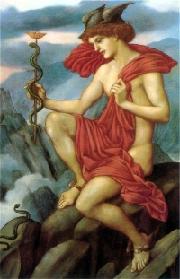
I've begun taking an astrology class with a teacher I admire utterly. I've been trying to get into her class for over a year, and I've finally managed. I'm intrigued and excited. This six-week term, we're talking about Mercury. (There he is in the picture.)
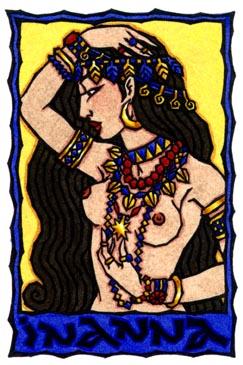
Here are some words and ideas associated with Mercury -

quicksilver / fugitive / changeable / imagination / trickster / mirror / communication / scoundrels & thieves / messenger / poisonous / morph / untrustworthy / reflector / traveller / deceitful / truth-telling liar / the poison that heals / bloodthirsty / an impudent demon

You know who that makes me think of? Spike from BtVS. (That's "Buffy the Vampire Slayer," for the uninitiated.)

My teacher said that Mercury in your chart is that part of your life you're always living, always returning to, always trying to figure out. "If you understand the person's Mercury, you understand what their life is about."

Each degree on the zodiac has a short description, a story or metaphor, attached to it. These are the Sabian symbols, and they're the keys to unlocking the meaning of the planets in your life. Our homework involves "working on" our Mercury symbols to start unlocking their meaning - through journaling, dreamwork, art, etc. My Mercury is at 24 degrees Aquarius. Its symbol is:

A man obviously of the world has turned his back on passion and is giving people a deep and undying wisdom.